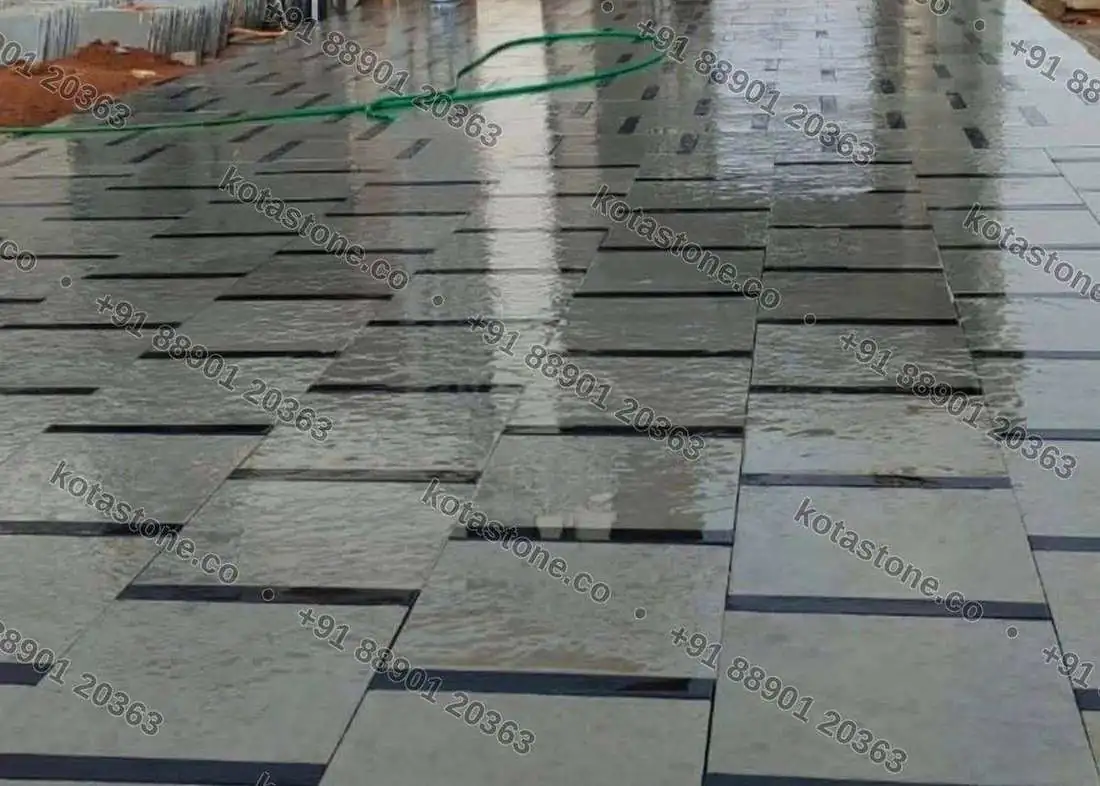
Kota limestone floors
Kota Stone Flooring
Kota stone is the default hard floor across most of northern and central India for one reason: it takes punishment for decades at a fraction of what marble or granite costs. It is not the right answer everywhere, though. This page is what we tell buyers on the phone — which thickness, which finish, where it works, where it does not, and what actually moves the rate.
What it is
A limestone, not a marble.
Kota stone is a fine-grained limestone quarried in a narrow belt around Ramganjmandi in Kota district, Rajasthan. It is dense, it is naturally slightly rough, and it wears rather than chips — which is why it survives in railway platforms, temple courtyards and school corridors long after tiles have failed.
The colour comes from the bed it is cut from. Grey (often called blue) is the common one and the most consistent. Green is denser and more expensive. Brown and honey tones come from the upper beds and vary more from lot to lot. None of it is dyed — what you see is the stone.
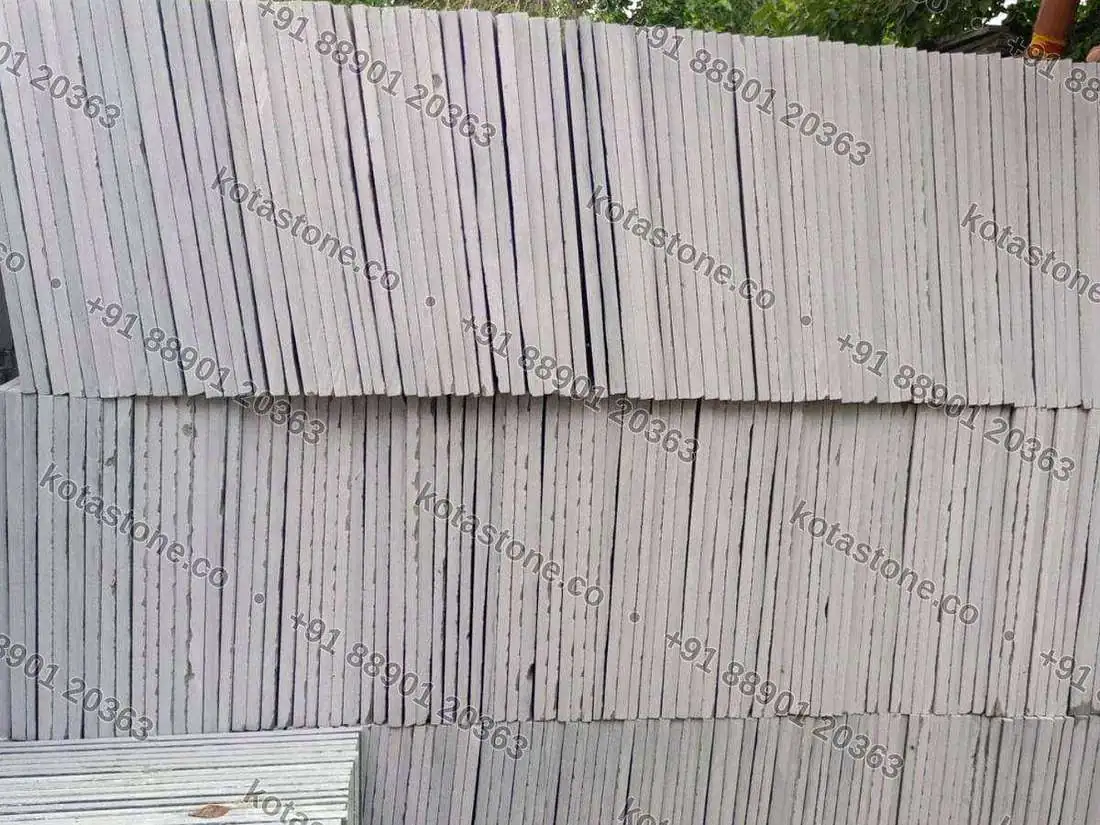
It is sold by the square foot, cut to size or as random slabs, in thicknesses from about 15 mm up to 40 mm and beyond for heavy-duty work.
Specify it right
Thickness by application
Thickness is the single biggest decision you make, because it drives both the strength of the floor and the price you pay. These are the thicknesses we actually cut for each job.
Surface
Which finish belongs on a floor
Finish changes appearance, slip resistance and maintenance — in that order of what people notice and the reverse order of what matters. Tell us where the floor is and we will tell you what to ask for.
Honesty
Where Kota stone is the wrong answer
- Kitchen counters and vanity tops. Kota is a limestone — lemon, vinegar, tomato and descaling acid will etch it. Use granite there and Kota on the floor.
- Unsealed external work in heavy salt air. On coastal sites we will steer you to basalt or a dense green Kota rather than a porous grade.
- Mirror polish anywhere that gets wet. It is a genuine slip hazard. Honed or leather in bathrooms, natural outside.
- Sites that cannot accept tonal variation. This is quarried stone, not a manufactured tile. Two lots from different beds will not match. If your floor has to be uniform across four thousand square feet, tell us and we will cut it from one batch and reserve it.
Questions
Kota Stone Flooring
What thickness of Kota stone should I use for house flooring?
20–25 mm covers almost all domestic flooring. Go to 25–32 mm for a veranda, a porch or anywhere semi-external, and 40 mm where a car drives. Below 20 mm you are relying entirely on the quality of the mortar bed.
Is Kota stone good for outdoor flooring?
Yes, in a natural, sawn or rock-faced finish — it is one of the best value external paving stones in India. Do not use a mirror polish outdoors: it becomes slippery when wet and the shine will not last under UV and rain.
How long does a Kota stone floor last?
Properly laid on a sound bed, indefinitely in domestic use — Kota floors from decades ago are still in service across Rajasthan and Madhya Pradesh. It wears slowly and evenly rather than failing suddenly, and a worn floor can be re-ground and re-polished in place rather than replaced.
Does Kota stone need sealing?
For internal floors, no — regular mopping is enough, though a penetrating sealer helps in kitchens and near dining areas where oil is spilt. For external work and for the more porous brown grades, a breathable sealer is worth the cost.
What is the price of Kota stone flooring?
It starts from about Rs 9 per square foot and rises with thickness, size, grade, finish, polish, quantity, labour and freight. There is no single rate, and anyone quoting one number without asking about your specification is guessing. Send us the specification and a delivery pin code and we will give you a real figure.
Is Kota stone cheaper than tiles?
Per square foot of material, usually yes at the lower grades, and it lasts far longer than a vitrified tile under heavy traffic. The comparison changes once you add laying labour and in-situ polishing, which a tile does not need. Our comparison guide sets both out properly.
Related
Where to go next
Kota stone rates
What actually drives the price, and how to ask for a real one.
See the range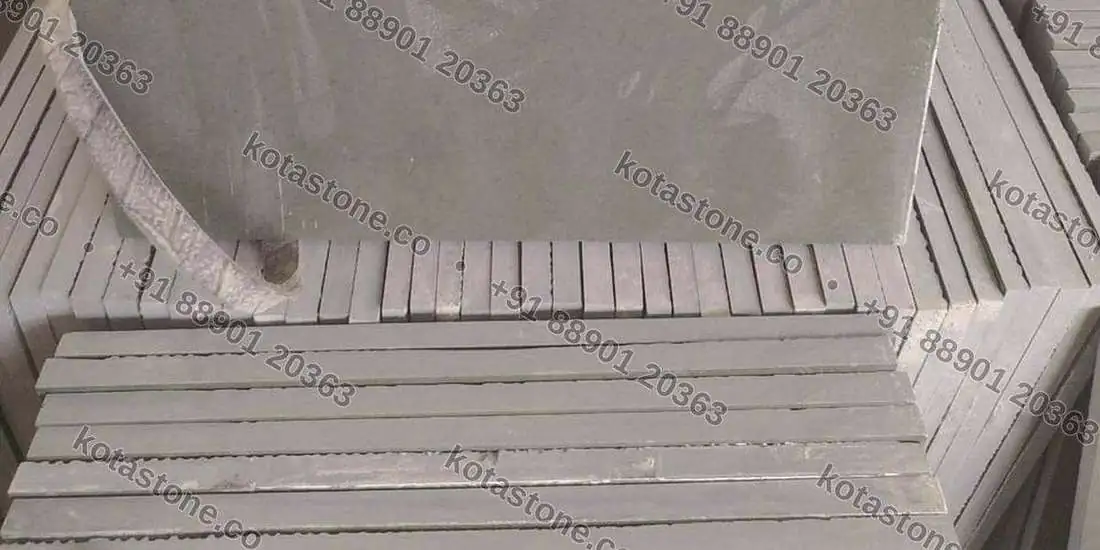
Sizes & thickness
Every size we cut, with weight and coverage per square foot.
See the range
All twelve finishes
Natural through mirror polish, with where each one belongs.
See the rangeHow it is laid
Substrate, mortar bed, jointing, grinding and first polish.
See the rangeKota vs marble, granite & tiles
An honest comparison on cost, durability and maintenance.
See the range
Care & maintenance
Keeping a Kota floor right, and repairing one that has gone wrong.
See the rangeNext step
Ask for today’s rate.
Send the size, thickness, finish and quantity with your pin code. You get an ex-yard rate, a delivered rate, and an honest lead time.