Daily and weekly
Sweep or dry-mop to lift grit — grit underfoot is what actually abrades a polished surface, far more than shoes. Damp-mop with plain water, or with a pH-neutral stone cleaner diluted per the label. Wring the mop out properly; standing water on any stone floor eventually finds its way into the bed.
Wipe spills promptly. Anything acidic — citrus, vinegar, wine, tomato, cola, descaler — will etch a polished limestone surface within minutes, leaving a dull mark that cleaning cannot remove.
What never to use
- Acidic cleaners of any kind: hydrochloric acid, vinegar, lemon, most bathroom and toilet cleaners, limescale removers. Kota is calcium carbonate; acid dissolves it.
- Acid washing to clean cement residue after laying. This is still done on Indian sites and it permanently damages the surface. Use a proprietary cement film remover formulated for limestone instead.
- Bleach and strong alkalis at concentration — they can discolour and dull the finish.
- Abrasive powders and scouring pads on a polished floor.
- Steam cleaners at high temperature on sealed floors — they break down impregnating sealers.
Sealing
Kota's water absorption is under 0.4%, so it is already among the least porous natural stones you can lay. Sealing is still worthwhile in kitchens, bathrooms, dining areas and any exterior surface exposed to leaf staining or vehicle drips.
Use a penetrating impregnating sealer, not a surface coating. Impregnators sit inside the pore structure and let the stone breathe; film-forming coatings look good for six months and then peel, and stripping them off is a miserable job. Reapply every two to four years indoors, more often on heavily used exterior paving.
The test
Drop a little water on the floor and wait five minutes. If it beads or sits, the seal is intact. If it darkens the stone, it is time to reseal. Do this once a year and you will never be caught out.
Stains
| Stain | Treatment |
|---|---|
| Oil and grease | Poultice of absorbent powder and acetone or a proprietary degreaser; cover, leave to dry, scrape off |
| Tea, coffee, wine | Poultice with a 12% hydrogen peroxide solution; test in a hidden area first |
| Rust | Proprietary rust remover formulated for limestone — never a general acid |
| Cement haze | Cement film remover safe for calcareous stone; never hydrochloric acid |
| Etch marks (acid damage) | Cannot be cleaned out — requires re-honing or re-polishing that area |
| Efflorescence | Dry-brush repeatedly; if it recurs, the source is moisture in the substrate and needs investigating |
Restoration
This is Kota's real advantage over tile. When a floor has been walked on for twenty or thirty years and looks tired, it does not need replacing — it needs grinding and re-polishing in place. A specialist takes the surface back with progressively finer diamond pads and brings up a new polish on the same slabs. It is dusty and it takes a few days, and it costs a fraction of a new floor.
The same process fixes localised etch damage, deep scratching and lippage. Practically speaking, a well-laid Kota floor is a permanent floor.
Exterior surfaces
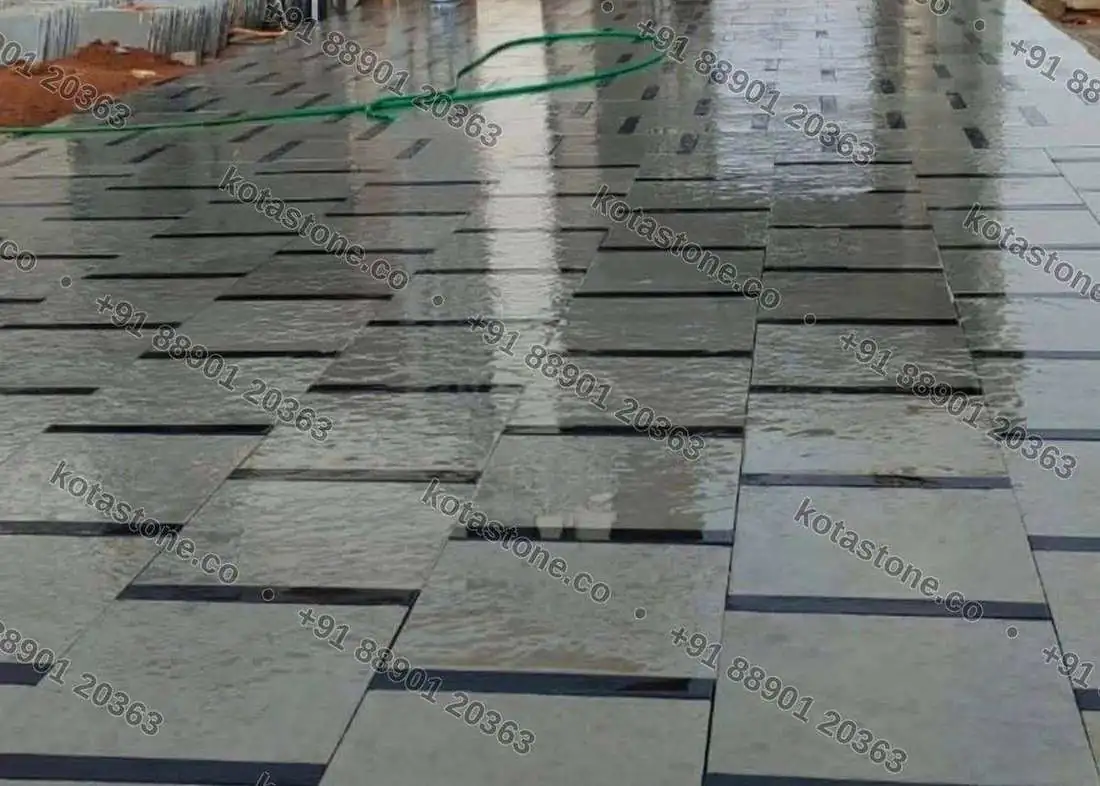
Sweep regularly and wash down with water and a stiff brush; a pressure washer on a low setting is fine on natural and rock-faced surfaces but keep it off the jointing. Treat algae and moss with a proprietary stone-safe biocide rather than bleach. Check the pointing annually and make good any open joints before water gets into the bed.
Published 12 January 2026 by Agrawal Stone Suppliers, Ramganjmandi, Kota. Every stone we write about passes through our own yard — if something here does not match what you are seeing on site, call us and we will talk it through.