
Crazy paving
Irregular flags with a honed face, sorted so the pieces close up with an even joint. Garden paths, courtyards and terraces where a grid would look too formal.
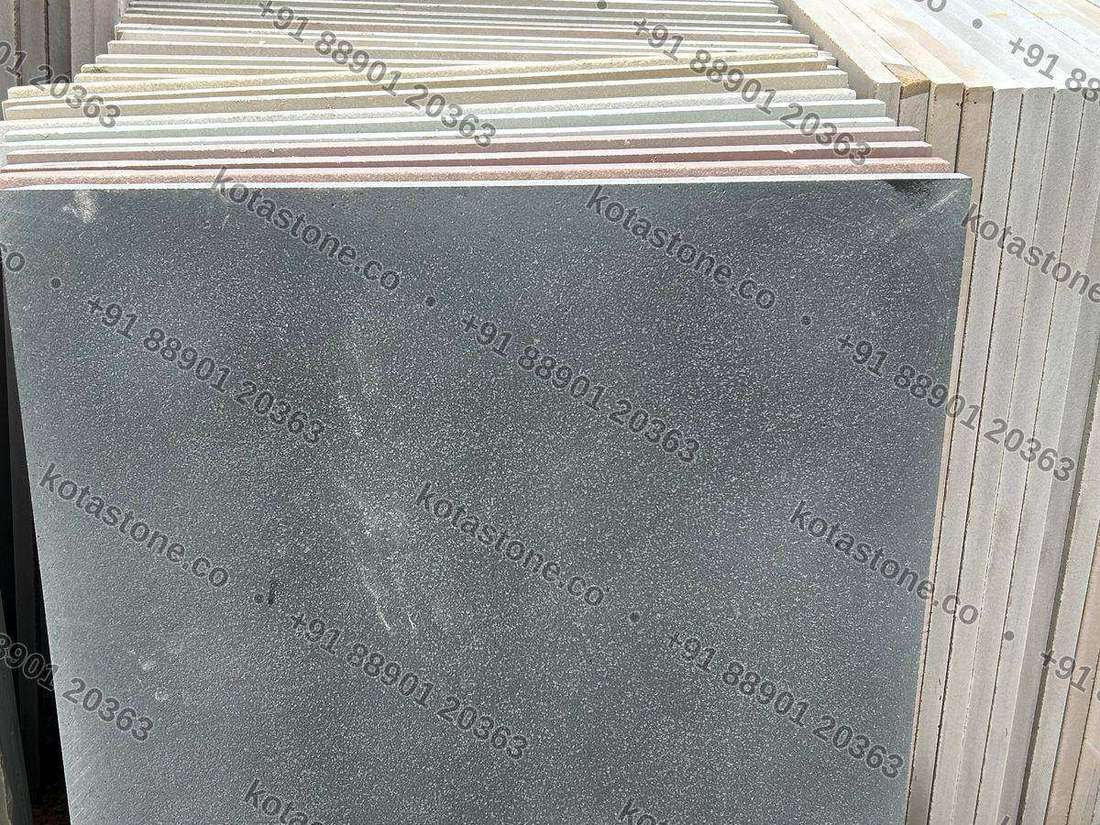
The hardest stone we supply
Volcanic rock from the Deccan Traps — dense, non-porous and close to three times the compressive strength of Kota. Where a floor or paving has to take genuine punishment, basalt is the answer.
The material
Basalt is igneous — lava cooled fast enough to form an extremely fine, tight grain with almost no bedding planes. India sits on the Deccan Traps, one of the largest basalt formations on earth, and Indian basalt is now a global reference material for heavy-duty paving.
If you searched for "black Kota stone," this is worth reading first. Kota limestone itself does not come in a true black — its natural palette is blue-grey, green and brown. What we supply for a genuinely black natural stone floor is this basalt: a different, harder rock entirely, not a colour grade of Kota. It costs more than Kota per square foot, but if black is the requirement, this is the honest answer rather than a stretch of the word "Kota."
The numbers are the point. Compressive strength runs 1,500 to 3,000 kg/cm², density 2,800–3,000 kg/m³, absorption under 0.5%. It does not stain, spall in frost, soften near salt water or fade. Airport aprons, city plazas, bus stations and pool decks are all natural basalt applications.
Visually it runs from jet black to charcoal, and the finish changes the reading completely. Flamed is matte charcoal with a high-grip face. Honed is a flat mid-grey-black. Polished goes to a near-mirror black that rivals imported granite at a fraction of the price.
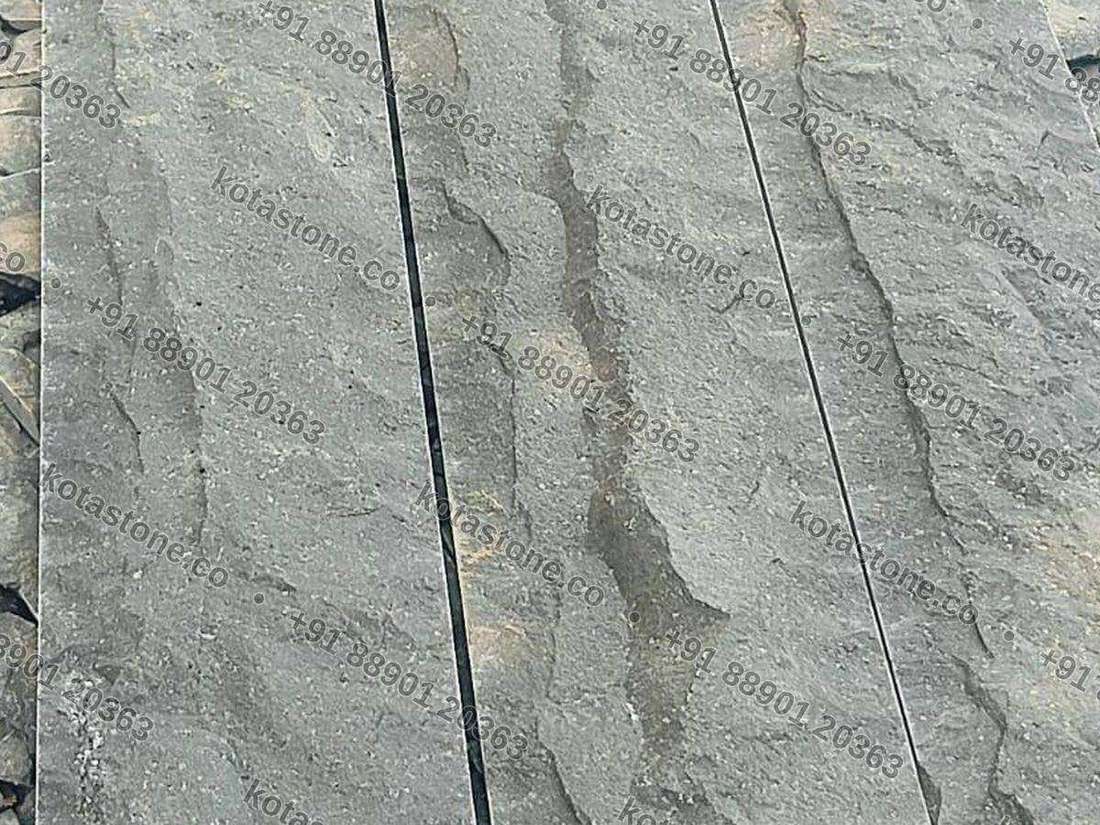
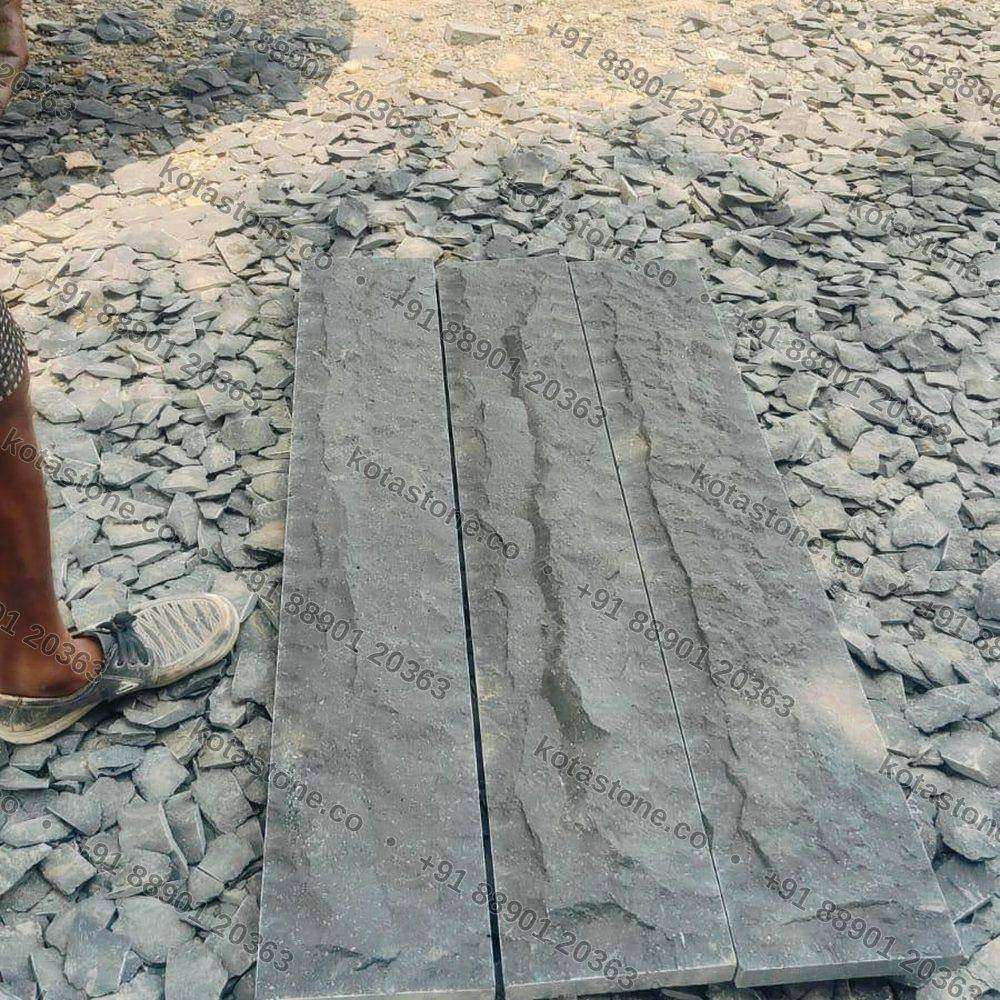
Rock-faced and flamed get confused constantly. Rock-faced is split and chiselled — sharp facets, strong directional grain, and what most people mean by a stone-clad feature wall. Flamed is thermal: the surface is heated until the outer crystals spall off, leaving a fine granular texture with no facets. Rock-faced is for elevations you look at; flamed is for floors you walk on. The photographs here are our own stock — rock-faced and flamed both.
It is the most expensive material on our list and it should be — it saws slower, costs more in consumables and yields less per block than a sedimentary stone. Specify it where the loading or the lifespan justifies it, and nothing else in the Indian range comes close.

The same basalt, nine ways. Texture decides the colour far more than the block does — worked faces read pale grey, sawn and polished faces read black.


Where it works
Technical
Grooved and diamond-cut
Every flat basalt face we sell starts on the diamond saw. The blade leaves a true, flat, closely gauged surface — that is what "diamond cut" means in this trade, and it is the face that every later treatment is worked onto. Left as it comes off the saw it is a clean mid-grey-black with faint blade travel across it.
Grooving is the anti-skid answer for basalt. Parallel grooves are cut into the sawn face at a set pitch, deep enough to break the water film and give a boot or a tyre something to bite on. Unlike flaming, grooving does not lighten the colour — the face stays black and the grip comes from the geometry, not from a roughened surface. It is what we supply for ramps, wet approaches, pool surrounds, loading aprons and any external stair that has to stay safe in the monsoon.
The same saw cuts pattern work. Crossed arcs, radial sweeps and border grooves are all cut on the machine to a drawing, not chased by hand, so every piece in a run matches. On a large slab a swept diamond cut reads as a single deliberate line across the floor rather than as a texture — worth specifying where the stone itself is the feature.
Groove depth, pitch and direction are all to order. Tell us whether the piece is a tread, a ramp or a floor and we will set the pitch to suit; the standard is a fine pitch on treads and a wider, deeper one on vehicle ramps.

Pattern work cut on the machine — crossed arcs across a full slab face. Cut to a drawing, so every piece in a run matches.

Grooved stock at Amarpura. The grooves run the length of the piece; pitch and depth are set to the job.

On the line at our unit. Grooving is a machine pass on the sawn face, not a hand-worked finish.
In the yard
All our own stock and our own yard at Amarpura — crazy paving, steps, cladding and finish samples photographed as they were laid, not rendered.
Irregular flags with a honed face, sorted so the pieces close up with an even joint. Garden paths, courtyards and terraces where a grid would look too formal.

Sawn treads over rock-faced risers — the combination most people ask for. The riser gives the shadow line; the tread stays flat and safe underfoot.

Rock-faced ledgestone in a running bond, alongside brick-pattern and plain panels. Built in the yard so you can see the shadow a real elevation throws.

Blocks as they arrive, buff-weathered outside and black through the core. Everything on this page is sawn out of stock like this.

The dark centre and the pale surround are the same basalt. Texture is what changes the colour, which is why a sample has to be in the finish you are actually buying.

Sandblasted faces with the black sawn edge still showing. The pale grey face is the abraded surface, not a different block.
Every photograph on this page is our own stock at Amarpura, Ramganjmandi. Ask for a sample in the finish you intend to buy — basalt changes more between finishes than any other stone we sell.
Sizes
Anything on this list is routine. Anything not on it, send the drawing.
| Size (metric) | Size (imperial) | Thickness | Typical use |
|---|---|---|---|
| 600 × 600 mm | 2′ × 2′ | 20, 25, 30 mm | General paving and flooring |
| 600 × 900 mm | 2′ × 3′ | 25, 30 mm | Large-format paving |
| 300 × 300 mm | 1′ × 1′ | 15, 18, 20 mm | Interior tiles, cladding |
| 300 × 600 mm | 1′ × 2′ | 18, 20, 25 mm | Cladding, treads, borders |
| 1200 × 600 mm | 4′ × 2′ | 25, 30 mm | Lobbies, feature floors |
| Gangsaw slabs | Bed-run | 18 – 30 mm | Counters, cut-to-size stock |
| Cut to size | Any module on drawing | 15 – 100 mm | Kerbs, channels, copings, counters |
| Cobbles & setts | 50×50, 100×100, 100×200 mm | 40 – 60 mm | Driveways, plazas, edging |
Dimensions are nominal. Calibrated material is held to ±1 mm on thickness. See the full size and weight reference for coverage and truckload figures.
Comparison
All four stones are supplied from our unit. The right one is decided by loading, exposure and budget, not by preference.
| Stone | Compressive strength | Water absorption | Density | Best suited to |
|---|---|---|---|---|
| Kota limestone | 1,800 – 2,200 | Under 0.40% | 2,400 – 2,600 | Interior floors, courtyards, heavy foot traffic |
| Mandana sandstone | 800 – 1,200 | 1.0 – 2.0% | 2,200 – 2,400 | Exterior paving, cladding, heritage work |
| Kandla Grey sandstone | 1,100 – 1,600 | 0.5 – 2.0% | 2,200 – 2,400 | Patios, driveways, export paving |
| Raj Green sandstone | 1,000 – 1,500 | 1.0 – 3.0% | 2,200 – 2,400 | Patios, garden paving, terraces |
| Black basalt | 1,500 – 3,000 | Under 0.50% | 2,800 – 3,000 | Public plazas, transit, heavy-duty paving |
Compressive strength and density in kg/cm² and kg/m³. Figures are typical ranges for commercially graded material, not guaranteed test certificates — ask us if your specification requires certified testing.
Samples
No screen renders stone honestly. Tell us the finish you are considering and we will courier physical pieces.
Next step
We quote ex-yard Ramganjmandi or delivered to your site anywhere in India. Physical samples dispatched on request.
Welcome to the Star Group family. Every piece here is personally checked and sorted by us before it leaves Ramganjmandi.