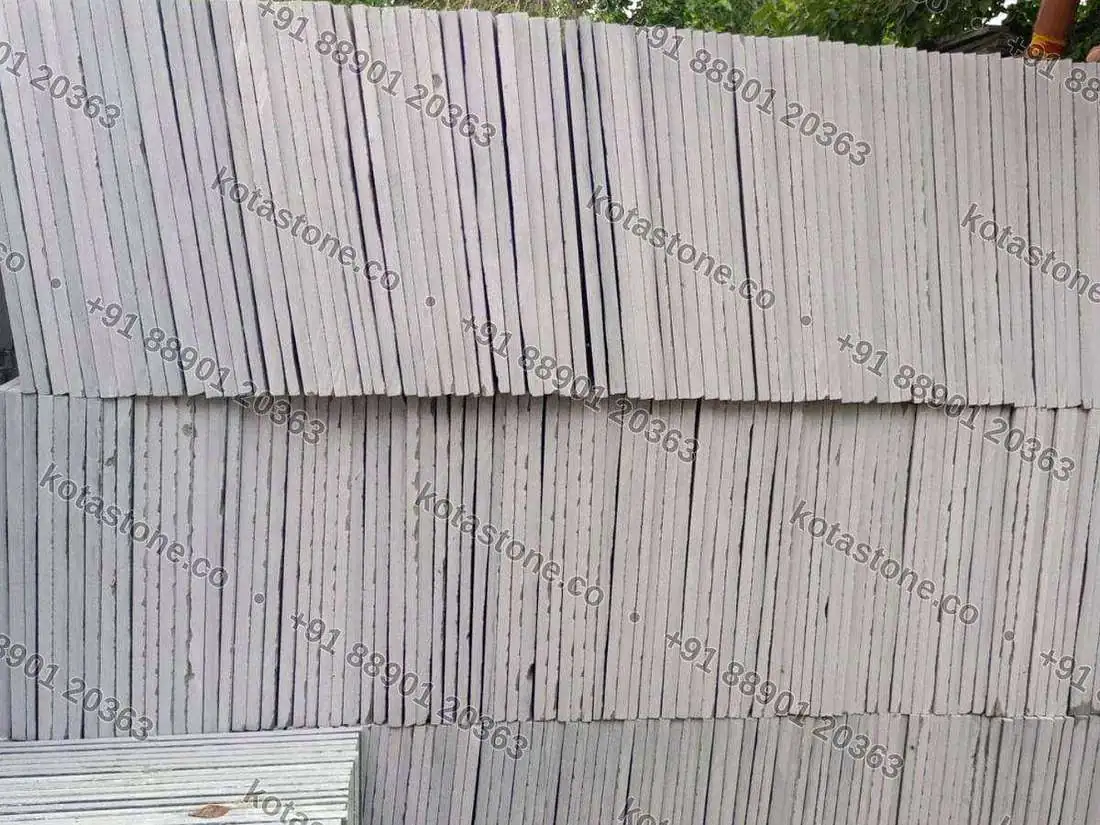
Kota limestone
Kota Stone
Grey, green and brown limestone from the Ramganjmandi belt — processed at our own unit or sourced from quarries and yards we trust, then cut to whatever your drawing says. You will also see it sold as Kota Pathar, Kotah stone or Cotta stone; it is all the same limestone, out of the same belt.
The material
What Kota stone actually is
Kota stone is a fine-grained calcareous limestone quarried in the Ramganjmandi belt of Kota district, Rajasthan. It forms in tight, naturally layered beds, which is why it splits cleanly along the bed plane and calibrates with very little waste — and why it has been the default hard-wearing floor in Indian public buildings for well over a hundred years.
Its numbers are the reason. Water absorption under 0.4% means it does not soak, stain or flake. A compressive strength of 1,800–2,200 kg/cm² means it takes trolleys, vehicles and industrial loading. And because it is a stone rather than a fired tile, a floor that has been walked on for thirty years can be ground and re-polished in place rather than ripped out.
It comes in three commercial colours — grey, green and brown — and the difference between them is bed, not treatment. Grey is the most abundant and most economical. Green is denser, takes the best polish and carries a premium. Brown runs honey to tan and is the warm option for exteriors. All three are available mirror-polished in 22″ squares, or unpolished in fresh or medium quality — fresh rough-faced, medium diamond-cut.
Technical properties
The range
Colours and grades
Grey / Blue Kota Stone
The classic blue-grey limestone. Blue-grey to dove grey (blue Kota).
View specification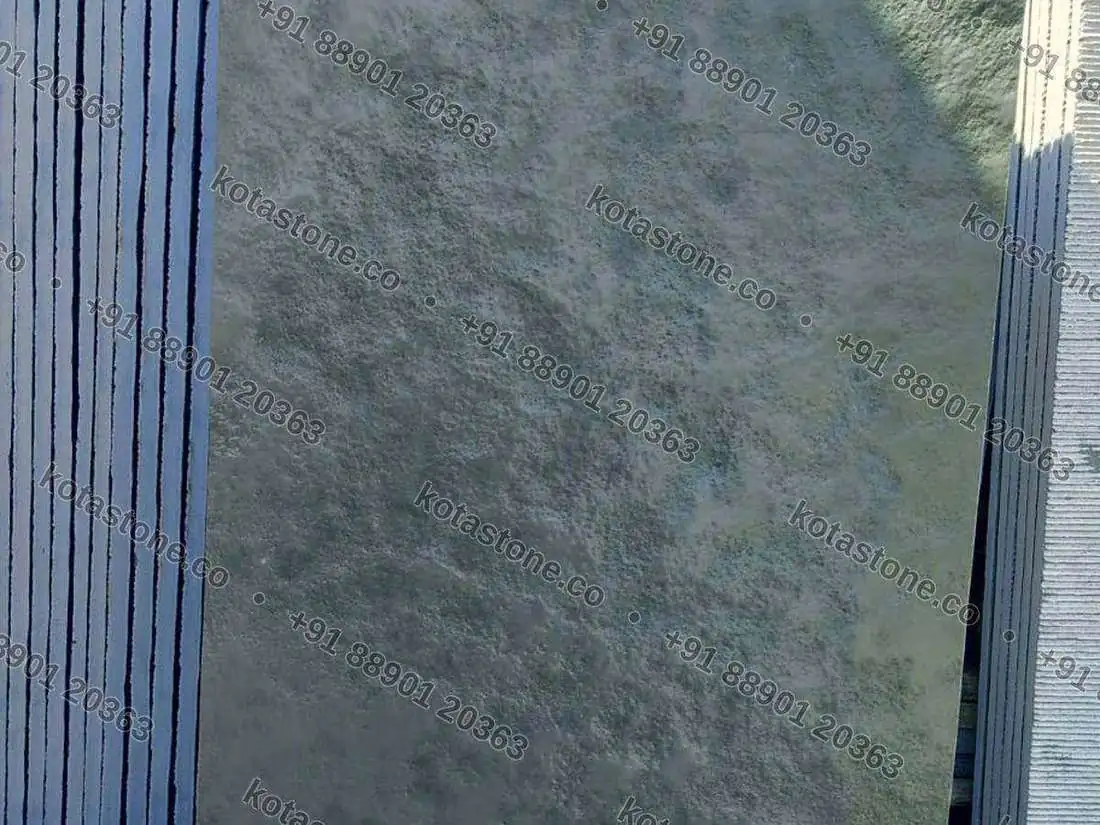
Green Kota Stone
Deep green, the premium grade. Deep olive to blue-green.
View specification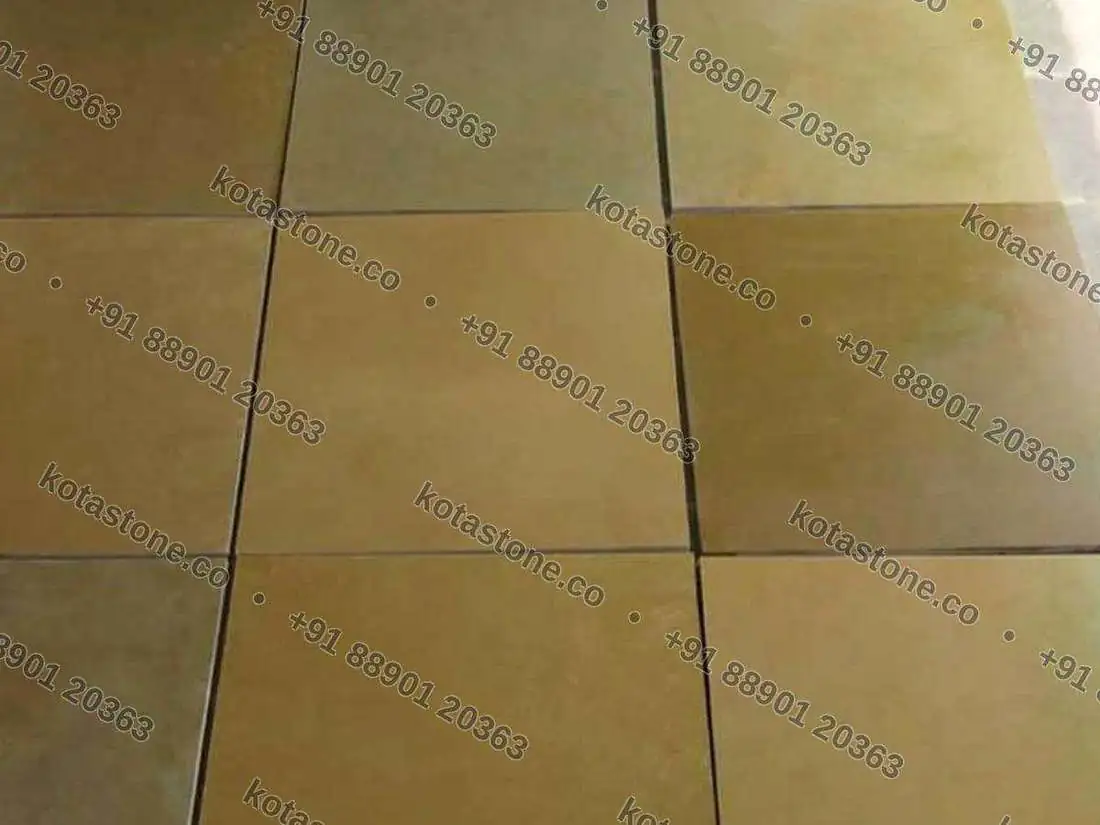
Brown / Honey Kota Stone
Warm honey tones for exteriors. Honey, tan and light chocolate.
View specification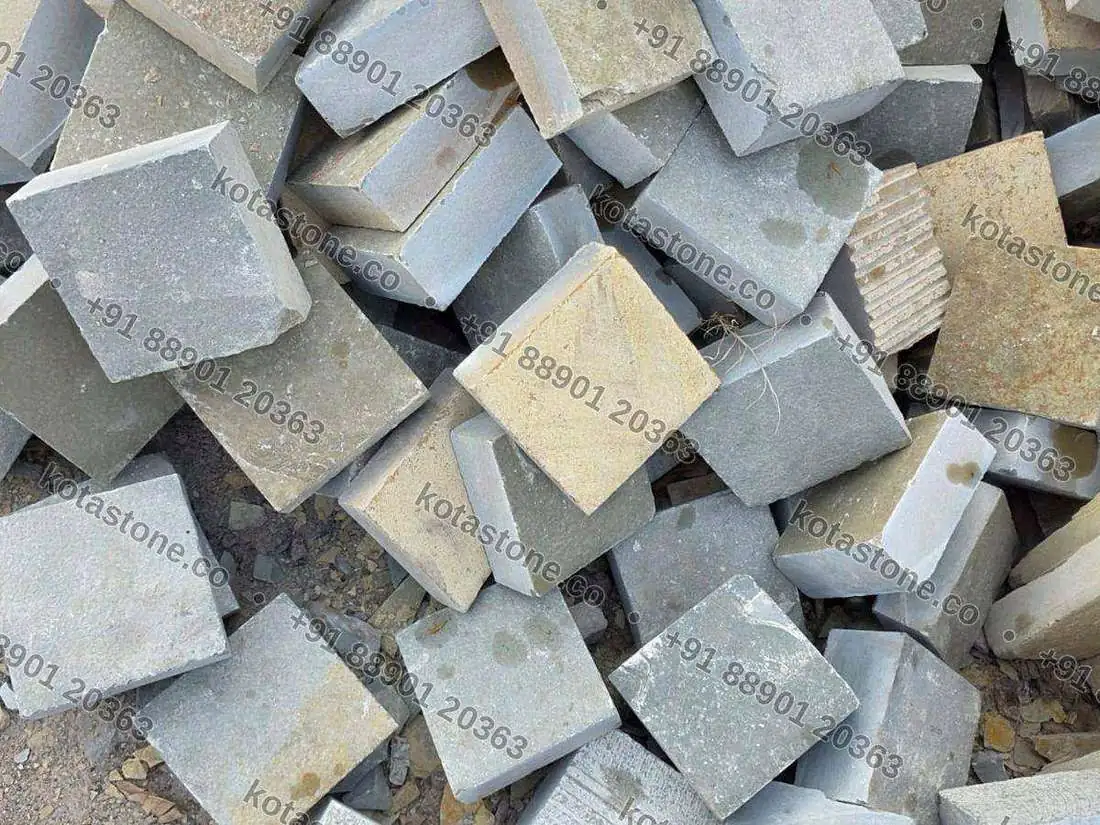
Kota Stone Cobbles
Hand-cut paving units. Blue and brown.
View specificationSizes & thickness
Standard formats we hold and cut
Anything on this list is routine. Anything not on it, send us the drawing — almost everything is cuttable.
| Size (metric) | Size (imperial) | Thickness | Typical use |
|---|---|---|---|
| 610 × 610 mm | 2′ × 2′ | 20, 25, 30, 40 mm | General flooring, courtyards |
| 610 × 305 mm | 2′ × 1′ | 20, 25, 30 mm | Corridors, treads, borders |
| 305 × 305 mm | 1′ × 1′ | 18, 20, 25 mm | Bathrooms, small areas, cladding |
| 914 × 610 mm | 3′ × 2′ | 25, 30, 40 mm | Large-format interior floors |
| 1220 × 610 mm | 4′ × 2′ | 30, 40, 50 mm | Lobbies, plazas, feature floors |
| Random slabs | Bed-run lengths | 25 – 60 mm | Paving, cladding, cut-to-size stock |
| Cut to size | Any module on drawing | 15 – 60 mm | Treads, risers, sills, copings, counters |
| Cobbles & setts | 100×100, 100×200 mm | 40 – 60 mm | Driveways, paths, ramps |
Dimensions are nominal. Calibrated material is held to ±1 mm on thickness; cut-to-size work to ±1 mm on length and width.
Choosing
Which colour, and in what finish?
| If you are doing this | Specify | Finish | Thickness |
|---|---|---|---|
| Interior domestic flooring | Grey or green Kota | Honed | 20–25 mm |
| Lobby or showroom floor | Green Kota | Mirror polished | 25–30 mm |
| Corridors, institutional floors | Grey / Blue Kota Stone | Honed or sawn | 25 mm |
| Bathroom or wet area | Grey or green Kota | Grooved anti-skid | 20 mm |
| Courtyard or terrace paving | Brown or grey Kota | Natural | 30–40 mm |
| Driveway or parking | Brown Kota cobbles | Natural split | 50–60 mm |
| Feature wall or facade | Green or grey Kota | Rock-faced | 20–30 mm |
| Staircase treads and risers | Green or grey Kota | Honed, grooved nosing | 30–40 mm |
| Counter or vanity top | Green Kota | Leather | 20–30 mm |
Questions
Common questions
What is Kota stone?
Kota stone is a fine-grained limestone quarried around Ramganjmandi in Kota district, Rajasthan. It is dense, naturally non-slip when left unpolished, and hard enough to take a mirror polish. It comes in grey (sold as blue), green and brown, and it has been used for Indian flooring for over a century because it lasts and it is cheap to maintain.
What thickness does Kota stone come in?
We cut from about 18 mm up to 40 mm and beyond. As a working guide: 18–20 mm for wall cladding and light interior floors, 25 mm for general residential and commercial flooring, 30–40 mm for driveways, heavy traffic and external paving. Calibrated material holds a consistent thickness across the lot, which is what thin-bed laying needs.
Is Kota stone good for flooring?
For a hard-wearing floor at a sensible rate, it is hard to beat. A properly laid Kota floor runs forty years with nothing more than sweeping, the right mop and a re-polish once every couple of decades. It is cooler underfoot than tile in summer, it does not chip at the edges the way vitrified tile does, and damage can be ground out rather than replaced.
What is the difference between blue Kota and grey Kota?
There is none. It is the same stone under two names — the trade calls the cool blue-grey material blue Kota, and the specification usually calls it grey Kota. If a supplier quotes you differently for the two, ask why.
Finishes
Most colours come in every finish we run.
Twelve surface treatments, from the raw quarry face to a full mirror polish — see the finishes page for which ones run on which colour.