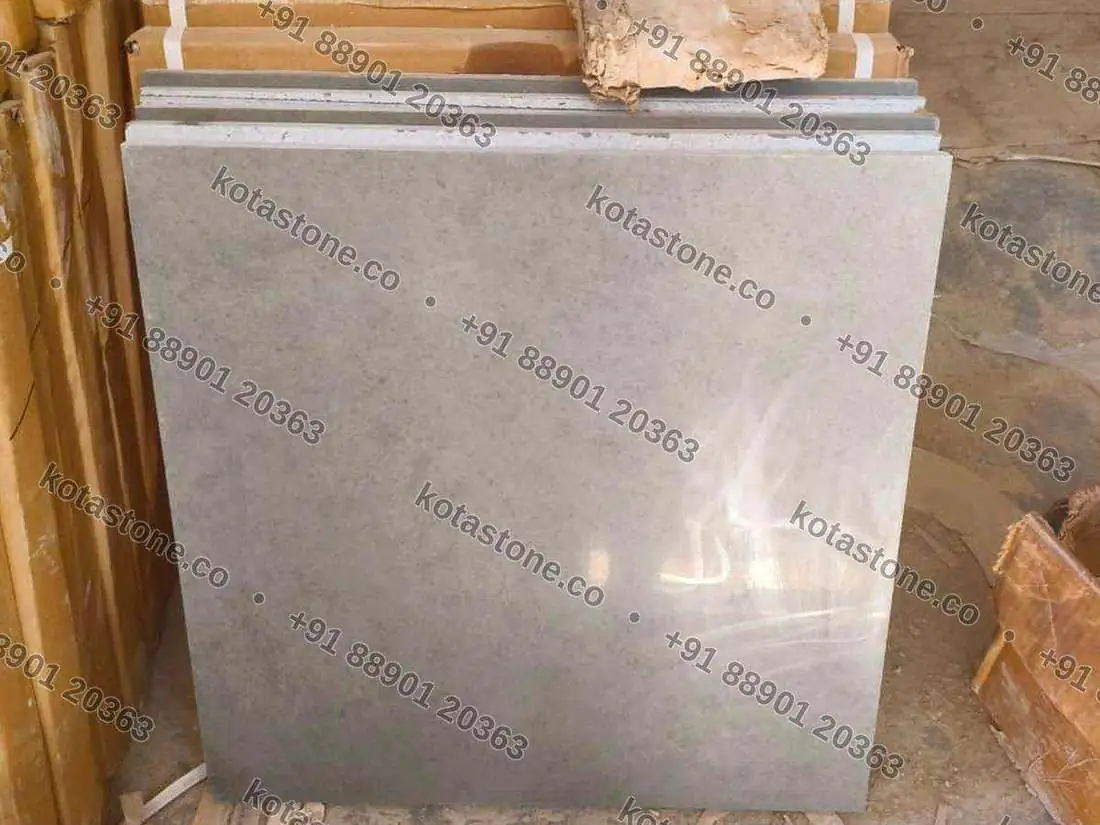
Mirror face, machine-calibrated back
Kota stone high polish, 22″ × 22″
Grey Kota taken to a full mirror polish and calibrated to a consistent thickness — the specification for thin-bed adhesive floors where the finished level has to be exact.
Two processes, one slab
Polish is the face. Calibration is the back.
Two separate processes are happening here and it is worth keeping them apart. High polish is what happens to the face: progressive diamond abrasives take the surface from sawn through honed to a full reflective gloss, which deepens grey Kota from a flat dove grey to a near-charcoal with real depth. Calibration is what happens to the back: the slab is machine-ground so every piece in the consignment is the same thickness within about a millimetre.
You can buy either on its own. Together they let a floor go down on thin-bed adhesive instead of a thick mortar bed — faster to lay, far less material, and a finished level you can predict from the drawing. On a large floor the labour saving alone usually covers the premium.
The photographs here are our own stock at 22″ × 22″. In the stack shots you are seeing the slabs edge-on: that regular combed pattern along the edges is the grinding, and it is the visual proof the thickness is machine-controlled.
One thing to be clear about — a mirror-polished limestone floor is a dry-interior floor. It is slippery wet and Kota is calcareous, so acid etches it. Specify it for lobbies, showrooms, offices and homes, and specify honed or grooved for the bathroom.
Also available in

Our own polished stock, photographed at the yard. Grey Kota goes near-charcoal under a full polish.
At a glance
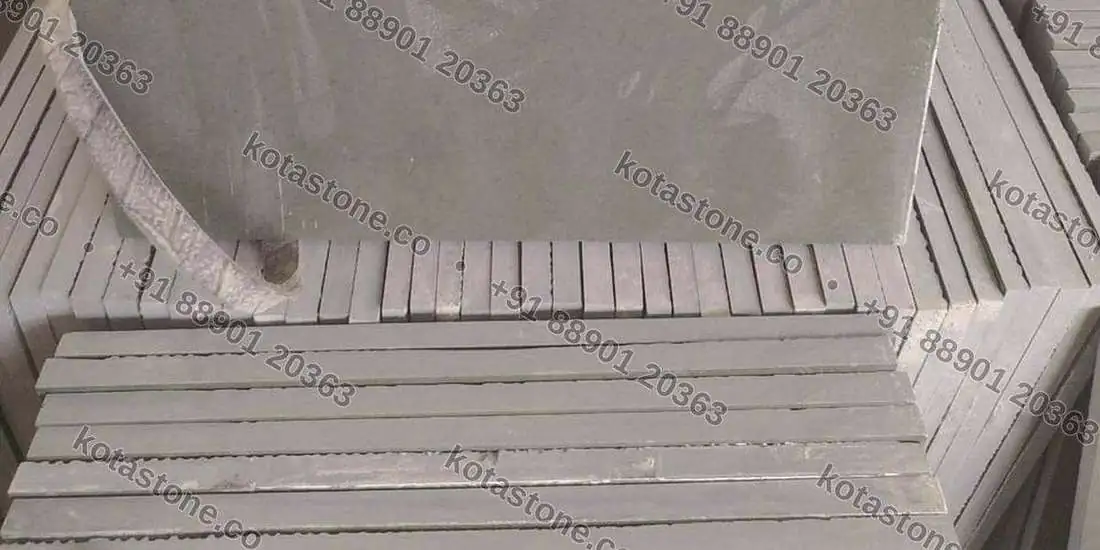
Calibrated slabs seen edge-on. That regular combed pattern along the edges is the grinding — visual proof the thickness is machine-controlled, not left as the bed gave it.
Why calibrate
What the premium actually buys you.
- Thin-bed adhesive becomes possible. Uncalibrated stone needs a thick mortar bed to absorb thickness variation. Calibrated stone does not.
- Predictable finished level. The floor lands where the drawing says, which matters at thresholds, lift openings and against existing work.
- Faster laying. No packing, no shimming, no lifting a slab back out because it sat proud of its neighbour.
- Less material. A few millimetres of adhesive instead of 30–40 mm of mortar across the whole floor.
- No lippage. Adjacent slabs sit flush, which is the difference between a floor that looks laid and one that looks installed.
When not to bother
If a traditional thick mortar bed is going down anyway — and on most Indian residential sites it is — calibration buys you speed and level accuracy but not much else. Skip it for random paving, rustic exteriors and cobbles.

The other option
High polish without calibration.
Not every job needs a calibrated back. We hold the same mirror polish on uncalibrated 22″ squares, and for a traditional thick mortar bed it is the more sensible buy — you are paying for the face, not for a flatness the mason is going to bury anyway.


Which one to buy
| Calibrated | Non-calibrated | |
|---|---|---|
| Back | Machine ground | As sawn |
| Thickness spread | ±1 mm | ±3 mm typical |
| Lays on | Thin-bed adhesive or mortar | Mortar bed only |
| Bed thickness | 3 – 6 mm adhesive | 20 – 40 mm mortar |
| Laying speed | Faster | Slower, more skill |
| Rate | Higher | Lower |
- Buy calibrated if you are laying on thin-bed adhesive, working to a tight finished level, or paying skilled labour by the day.
- Buy non-calibrated if a traditional 20–40 mm mortar bed is going down anyway. The bed absorbs the thickness variation and you keep the money.
- The face is identical. Same beds, same polishing line, same mirror finish. Calibration is a machining step on the back, nothing to do with appearance.
On video
See the polish move.
A still photograph flattens a mirror finish. This is eighteen seconds of our own 22″ polished stock in daylight — watch the reflection travel across the face as the camera moves. That is the thing no photograph on any supplier's website will show you.
No sound needed. The video only downloads if you press play.
Where it works
Typical applications
- Showroom and lobby floors
- Office and commercial interiors
- Residential living areas
- Reception and circulation space
- Wall cladding and dado
- Staircase treads and risers
- Skirting and borders
- Counter and table surfaces
Technical
Specification
Sizes
Calibrated formats
22″ × 22″ is the standard and what we hold in stock. Everything else is cut to order.
| Size | Metric | Sq ft / piece | Thickness | Notes |
|---|---|---|---|---|
| 22″ × 22″ | 559 × 559 mm | 3.36 | 17 – 18 mm standard | The standard calibrated square, held in stock |
| 24″ × 24″ | 610 × 610 mm | 4.00 | 18, 20, 25 mm | 2′ × 2′ module |
| 22″ × 11″ | 559 × 279 mm | 1.68 | 15, 18, 20 mm | Half module, borders, risers |
| 18″ × 18″ | 457 × 457 mm | 2.25 | 15, 18, 20 mm | Smaller rooms and cladding |
| 12″ × 12″ | 305 × 305 mm | 1.00 | 15, 18 mm | Cladding, dado, detail areas |
| Cut to size | Any module on drawing | By drawing | 15 – 30 mm | Treads, sills, counters, cut-outs |
Calibrated thickness held to ±1 mm. See the full size and weight reference for coverage and truckload figures, and the specification guide for when calibration is worth paying for.
Questions
Common questions
What is calibrated high polish Kota stone?
Grey Kota taken to a full mirror polish and then machine-ground to a consistent thickness across the whole lot. The polish is the look; the calibration is what makes it practical to lay on a thin adhesive bed with tight, even joints.
Should I buy calibrated or non-calibrated?
Calibrated if you are laying on adhesive over a level screed, which is most modern interior work — it costs more per square foot and saves more than that in labour and packing. Non-calibrated if you are laying on a traditional thick mortar bed where the mason levels each slab anyway.
What thickness is 22″ × 22″ polished Kota supplied in?
Typically 18–25 mm for interior flooring. Thinner is possible calibrated, because consistent thickness lets you go thinner safely — one of the real advantages of buying calibrated material.
Does polished Kota stone need sealing?
Not for durability — the stone is dense enough on its own. A sealer helps against staining in kitchens and around dining areas, where oil is the real enemy. Outdoors, do not use a polished finish at all.
Samples
A polished sample tells you more than any screen.
Depth of colour under a mirror polish is the one thing photography cannot convey. Ask and we will courier a piece.