The short version
Kota limestone is the most economical natural stone floor available in India by a wide margin, and it outlasts almost everything in its price band. Vitrified tile is cheaper still and more consistent in colour, but it cannot be refinished and it looks like what it is. Granite is harder and more stain-resistant but costs considerably more and offers a narrower palette. Marble is the softest and most beautiful, and the most demanding to keep.
If you want a hard-wearing natural stone floor at a sensible rate and you accept some natural variation, Kota is very hard to beat. If you want a flawless, uniform surface with zero tonal movement, buy tile and be happy.
Cost
Rates move constantly, so treat this as relative rather than absolute. Ranked from lowest to highest installed cost for a comparable interior floor:
| Material | Relative cost | Refinishable? | Typical life |
|---|---|---|---|
| Vitrified tile | Lowest | No | 10–20 years |
| Kota limestone | Low | Yes, repeatedly | 40+ years |
| Mandana sandstone | Low–moderate | Yes | 40+ years |
| Granite | High | Yes, with difficulty | 50+ years |
| Marble | High–very high | Yes | 50+ years, with care |
The number people miss is the refinishing one. A Kota floor that has been walked on for twenty-five years can be ground and re-polished in place for a fraction of what replacing a tile floor costs, and it comes back looking new. Over a building's life that changes the arithmetic significantly.
Durability
Kota's compressive strength runs 1,800–2,200 kg/cm² and its water absorption is under 0.4%. In practice that means it does not soak up water, does not flake in frost, and does not crack under the kind of loading a warehouse or a railway platform puts on a floor — which is exactly why it has been specified for those uses for a century.
Granite is harder on the Mohs scale and will resist scratching better. Marble, being softer and more porous, scratches and etches more readily. Vitrified tile is very hard on the surface but brittle through the body: drop something heavy and you get a chip you cannot repair.
Maintenance
Kota is a limestone, which means it is calcium carbonate, which means acid attacks it. Lemon juice, vinegar, descaler and acidic bathroom cleaners will etch a polished surface. Use pH-neutral cleaners and plain water and it will be fine for decades. The same warning applies to marble, more so.
Granite is chemically inert and shrugs off almost anything. Mandana sandstone, being silica-based rather than calcareous, is also far more acid-tolerant than Kota — worth knowing if you are specifying for an industrial or laboratory context.
A practical rule
Polished Kota indoors where it stays dry. Honed or leathered Kota indoors where it gets wet. Natural, rock-faced or grooved Kota and Mandana outdoors, always. Most of the complaints about Kota stone trace back to a polished floor specified somewhere it should never have been polished.
Appearance
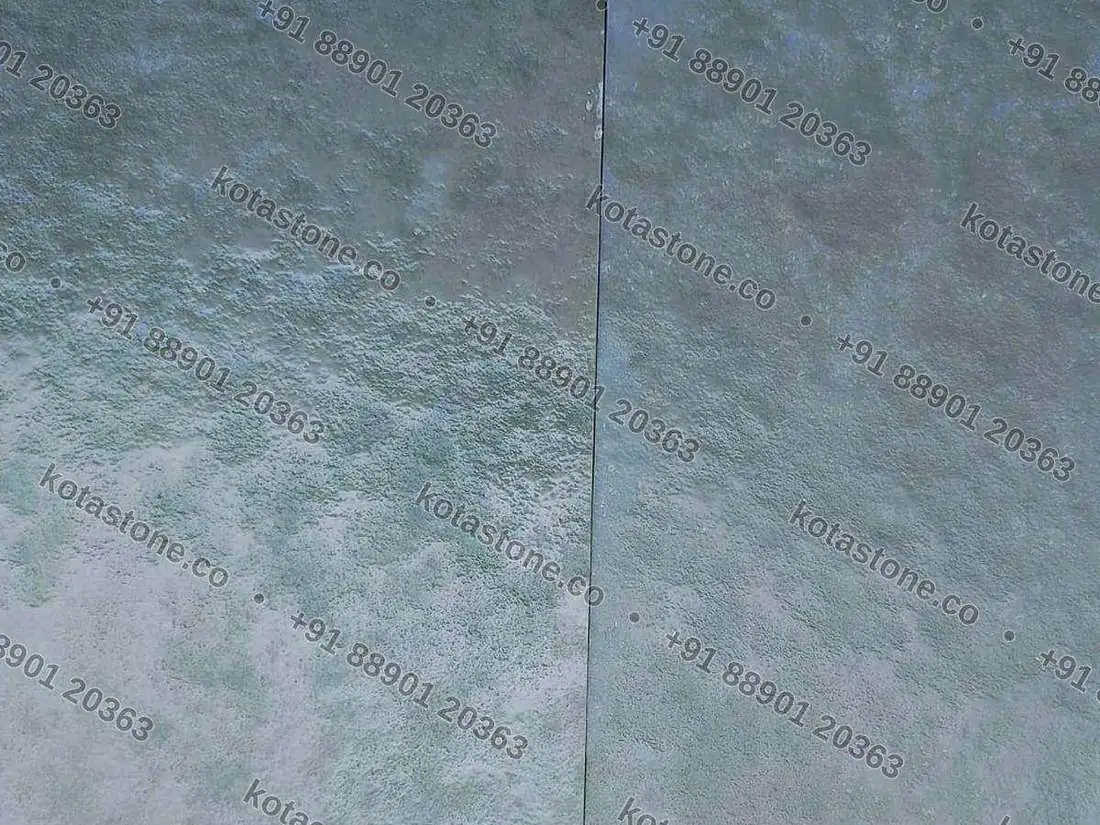
This is where the honest answer matters. Kota has natural tonal variation — slight shifts in colour and grain from piece to piece, and occasional veining. That variation is the point of natural stone, but if your client expects a floor as uniform as a printed tile, they will be disappointed unless you set the expectation and show them a laid-out sample area first.
Green Kota polished is genuinely striking, closer to a dark serpentine than to what people expect from a low-cost stone. Grey reads as calm and institutional. Brown reads as warm and rustic. Mandana red is unmistakably Rajasthani and carries a lot of visual weight; used across a large area it will dominate the scheme.
Where each one belongs
- Kota grey — corridors, staircases, courtyards, warehouses, institutional floors, anywhere durability matters more than drama.
- Kota green — lobbies, showrooms, feature floors and cladding where you want depth of colour at a natural-stone price.
- Kota brown — exteriors, driveways, garden work, and interiors that want warmth.
- Mandana — exterior paving and cladding, heritage work, and anywhere a silica-based stone outperforms a limestone.
- Granite — kitchen counters and heavy-chemical environments.
- Marble — low-traffic feature areas where appearance leads and someone will maintain it properly.
- Vitrified tile — tight budgets, rental properties, and clients who want absolute colour uniformity.
Published 18 March 2026 by Agrawal Stone Suppliers, Ramganjmandi, Kota. Every stone we write about passes through our own yard — if something here does not match what you are seeing on site, call us and we will talk it through.