The short version
Kota and Kadappa are cousins, not the same stone. Both are sedimentary limestone, both are quarried in India, both are dense, low-maintenance and inexpensive compared with granite — but they come from entirely different geological basins, and that shows up in colour more than anything else. Kota, from Ramganjmandi in Rajasthan, runs blue-grey, green and brown. Kadappa, from the Cuddapah basin in Andhra Pradesh, is black to grey-black, full stop.
If you want a genuinely black natural stone floor at a limestone price, Kadappa is usually the better-suited material — it was practically made for that job. If you want the wider colour range, the century-long track record in Indian public buildings, and a slightly better-known supply chain outside South India, Kota is the safer default. We supply Kota and Mandana sandstone, not Kadappa, so treat the Kadappa side of this page as a straight, disinterested comparison rather than something we are trying to sell you.
Colour and appearance
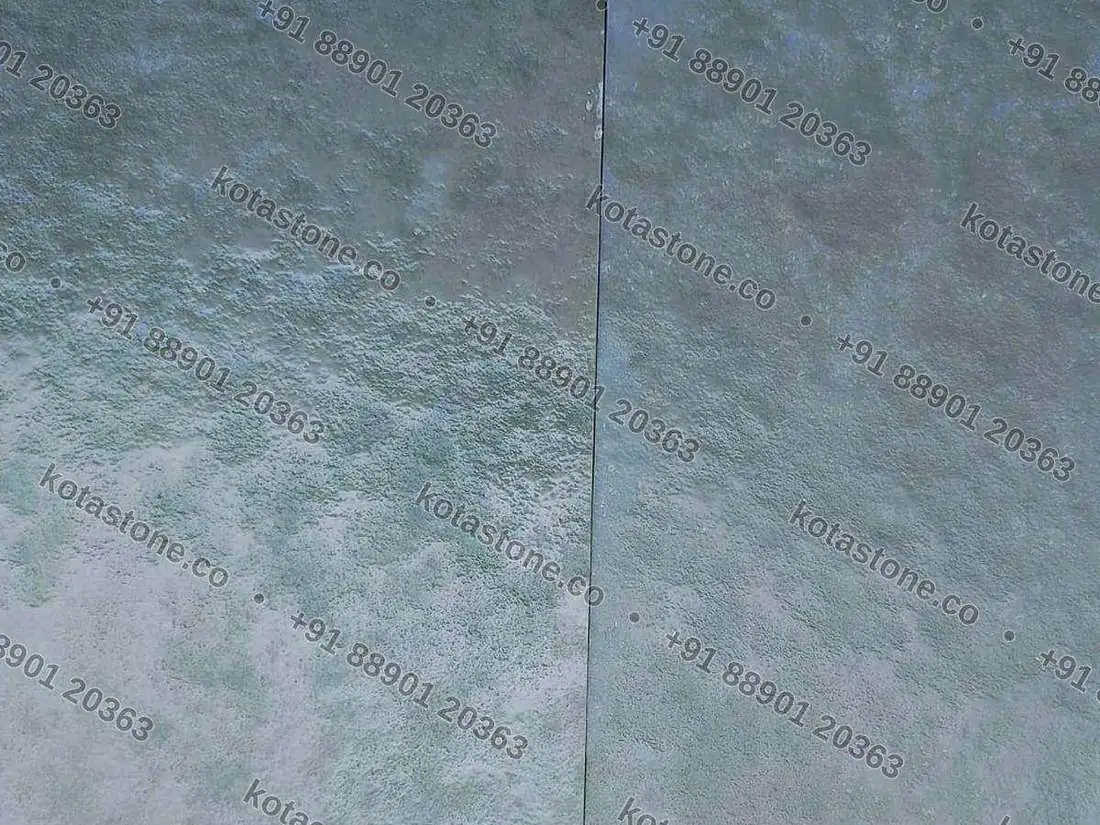
This is the real dividing line. Kota comes in blue-grey, green and brown/honey tones with natural veining and tonal movement — it looks like stone, with all the variation that implies. Kadappa is famously, uniformly black or near-black, which is exactly why it became the traditional choice for kitchen platforms, skirtings and cantilevered slabs across South India: a deep black surface hides daily marks and needs no colour-matching between pieces.
Strength and water absorption
| Property | Kota limestone | Kadappa / Cuddapah |
|---|---|---|
| Colour | Blue-grey, green, brown | Black, grey-black |
| Compressive strength | ~140–220 MPa | ~150–250 MPa |
| Water absorption | Low, ~0.4–1.5% | Very low, ~0.2–0.45% |
| Mohs hardness | ~3.5–5 | ~4–5 |
| Typical use | Flooring, cladding, paving, courtyards | Kitchen platforms, skirting, flooring, cladding |
Both numbers are good; Kadappa edges ahead on paper for water resistance, which is part of its long history in wet kitchen and utility areas. In practice, both stones perform well for standard flooring use for decades when specified and sealed correctly.
Cost
The two sit in a similar price band — generally within a short range of each other per square foot for a comparable thickness and finish, and both undercut granite substantially. Neither is reliably "the cheap one"; local supply and finish drive the actual number more than the stone type does.
Where each one belongs
- Choose Kota if you want a natural stone floor with colour variety — grey, green or brown — or you are matching an existing Kota installation, or you are outside South India where Kota supply chains are typically stronger.
- Choose Kadappa if the brief specifically calls for a black or near-black natural stone floor, kitchen platform or skirting, and you want that look without paying granite prices.
- Combine them — a Kota grey or green field with a Kadappa black border or skirting is a common, good-looking pairing, since both stones polish to a similar sheen.
Published 14 September 2026 by Agrawal Stone Suppliers, Ramganjmandi, Kota. We supply Kota limestone and Mandana sandstone, not Kadappa — this page exists to answer the comparison honestly, including the parts where Kadappa is the better fit.