Moulded cove skirting in Kota limestone and Mandana sandstone, supplied as a system — straight runs plus factory-cut internal and external corner pieces, so nothing has to be mitred on site.
The product
What cowin actually does
We call it cowin; the specification books call it coving or cove skirting. Same product — if your architect has written “coving” on the drawing, this is it.
It is the concave section that closes the joint where a floor meets a wall. Instead of a right angle that collects dirt and water and cracks along the line, you get a continuous sweep in the same stone as the floor. In temples, kitchens, dairies and wet areas that is not decorative — it is what makes the junction cleanable.
We sell it as a system rather than a single item, because a cove cannot be mitred on site the way flat skirting can. The corner pieces come cut to the same profile as the runs.
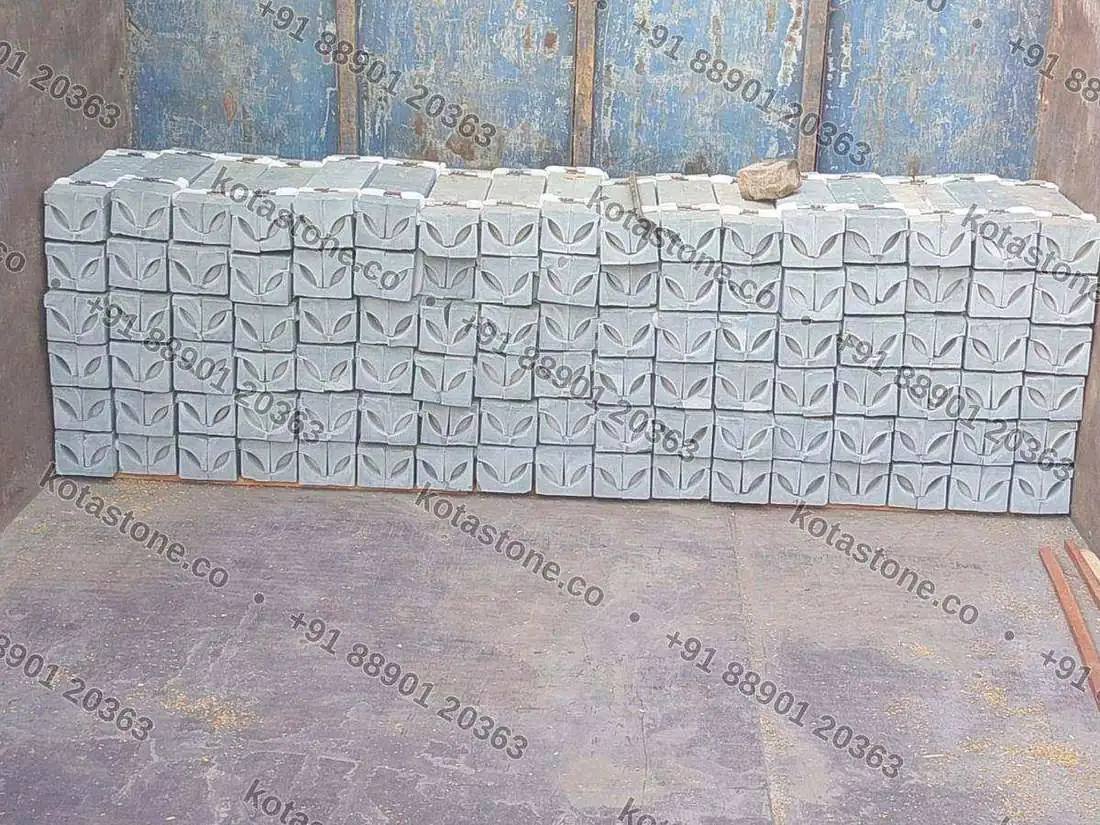
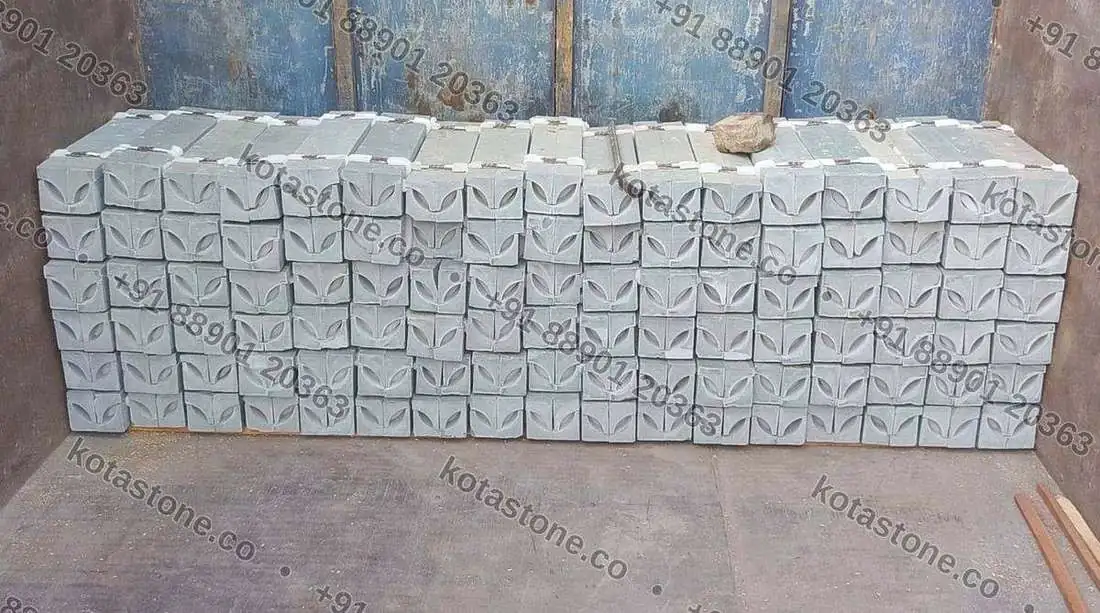
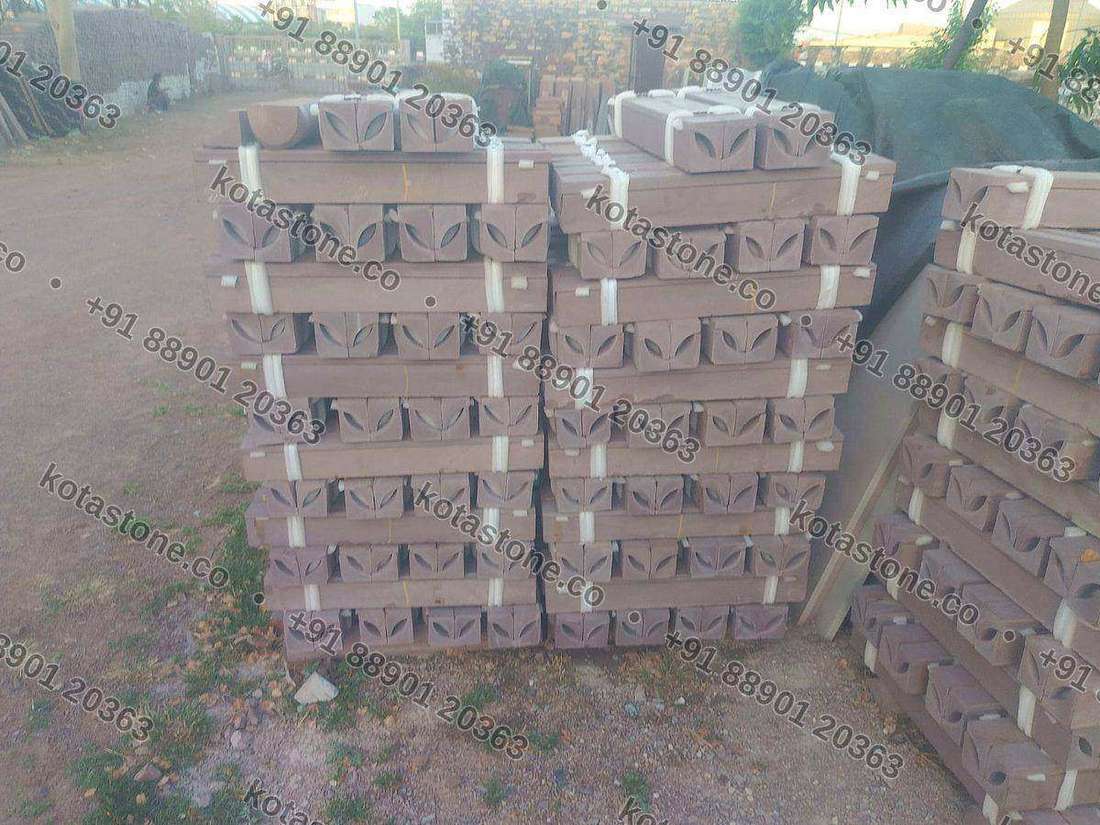
Packing differs between the two stones: Kota loads loose-stacked, profile face out; Mandana goes banded onto pallets. Both are stacked so the moulded face never carries the weight above it — a chipped cove edge cannot be hidden once it is laid.
Available finishes
NaturalSawnHoned finishTable polishMirror polish
Kota stone cowin stacked profile-face out. The repeated scoops are the cove section seen end-on.
This is the question every specifier asks and almost no supplier answers on their website, so here it is plainly: you do not mitre our cowin on site. We cut the corner pieces to the same profile as the runs, internal and external, and they arrive with the order.
Internal corners — for the inside angle where two walls meet, which is every ordinary room corner.
External corners — for pillars, returns, door reveals and any outside angle the run has to wrap.
Cut to the same profile as the straight runs, so the sweep is continuous through the angle instead of breaking at it.
Order them with the runs. Count your internal and external corners off the plan and tell us both numbers — they are separate pieces and they are not interchangeable.
We run the profile in both stones so the cowin matches the floor rather than approximating it. The same section is cut to order in Kandla Grey, black basalt, marble and granite as well — the two below are simply what we hold in stock.
Kota
Kota stone cowin
The grey-blue limestone. Specified with a Kota floor, and the one we move most of. Loads loose-stacked with the profile face out.
Mandana
Mandana stone cowin
The red-brown sandstone, for Mandana and red sandstone floors. Goes out banded and strapped on pallets rather than loose-stacked.
Where it goes
Typical applications
Floor-to-wall junction in place of a square skirting
Temple, ashram and institutional flooring
Kitchens, pantries, dairies and food-handling areas
Bathrooms, wash areas and wet rooms
Hospital and laboratory floors where corners must be cleanable
Courtyard and veranda plinth details
Staircase and landing junctions
Swimming pool surrounds and tank internals
If the floor has to be washed down rather than swept, cowin is usually worth the money. A square skirting joint is where the water sits.
Technical
Specification
ProductMoulded concave cove (scotia) section
Overall section63 mm wide × 70 – 75 mm high
Cove sweepStruck off a 4″ circle — 51 mm on each leg
Wall leg11 mm, grouted into the plaster
Floor leg20 mm, bedded into the floor
Run lengths20″ to 27″, in 1″ steps
Weight, coveAbout 4 kg a piece
Weight, cornerAbout 600 g a piece
MaterialsKota, Mandana red sandstone, Kandla Grey, black basalt, marble, granite
Corner piecesInternal and external, cut to the same profile
FinishNatural, sawn, honed or polished to match the floor
Packing, KotaLoose-stacked, profile face out
Packing, MandanaBanded and strapped on pallets
Cut to sizeNon-standard profiles made to drawing
Colour bodyThrough-body — a chip shows the same stone
The profile
Section and sizes
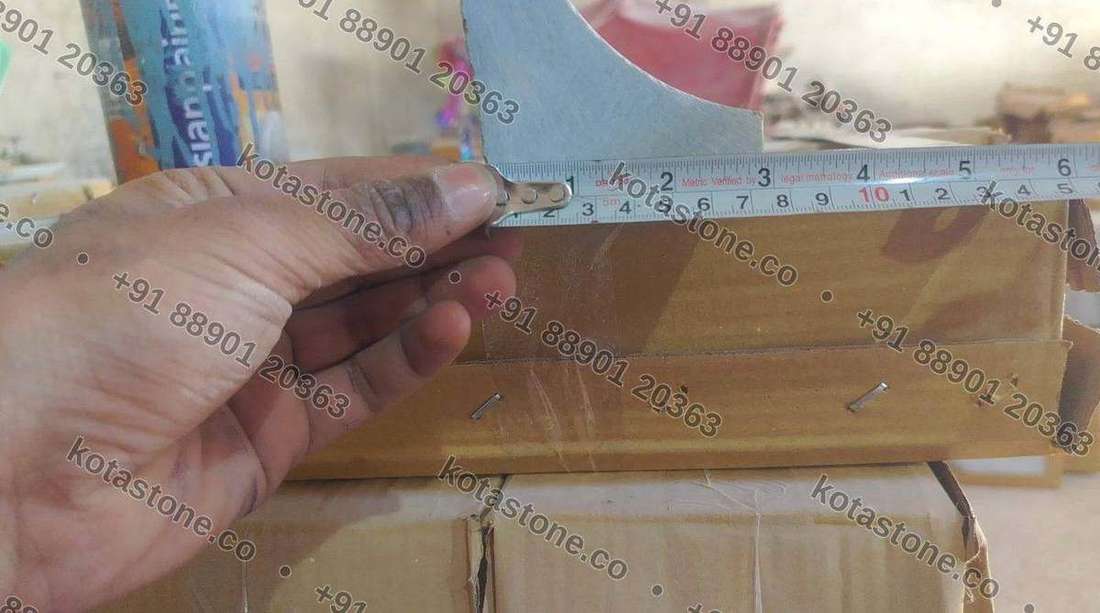
This is the section we cut: 63 mm wide by 70 to 75 mm high, with the sweep struck off a 4-inch circle so the cove reads as a true quarter round. The 11 mm wall leg disappears into the plaster and the 20 mm floor leg is bedded into the floor, which is why a finished run shows no joint at either end.
The section we cut. Sizes are approximate — stone is worked to a tolerance, not a machine part.
Item
Section
Length
Weight, approx.
Cove run
63 mm × 70 – 75 mm, 51 mm sweep
20″ – 27″, in 1″ steps
4 kg per piece
Internal corner
Cut to the same profile
Corner piece
600 g per piece
External corner
Cut to the same profile
Corner piece
600 g per piece
Cut to drawing
Any sweep or section
To order
By the section
On the short lengths: 20″ and 21″ together come to only 2 – 3% of any lot. The bed does not yield them in quantity, so a run specified entirely in short pieces cannot be filled — set the job out around 22″ and up, and take the short lengths as they come.
At about 4 kg a piece, a tonne runs to roughly 250 pieces — around 500 running feet on an average 24″ length, which is the figure you want when working out freight. Non-standard sweeps, stop-ends and radiused runs are all made to drawing. Send the section you want and we will tell you what is achievable in the stone before anything is cut.
On site
Getting a cowin run right.
A cowin run is unforgiving of a bad setting-out because the eye reads the curve as a continuous line. Break the line and everyone sees it.
Set the corners first. Place every internal and external corner piece, then cut the straight runs to fit between them. Working the other way round leaves you short at the angle.
Lay the cowin after the floor so the cove sits on a finished level and the sweep starts where the floor actually finishes, not where it was meant to.
Bed it solid. A hollow behind a cove is where it cracks the first time something knocks it.
Match the finish to the floor. A polished floor with a natural-finish cove reads as an afterthought. Specify both together.
Count the corners off the plan and add a couple. A broken corner piece on site with no spare stops the run.
Protect the moulded edge during the rest of the build. It is the first thing a scaffold board takes out.